
Internet Essentials to Reach More Than 40 Percent of All HUD-Assisted Households Nationwide

Internet Essentials Photo
Today from Washington D.C., Julián Castro, Secretary of the Department of Housing and Urban Development, and Comcast executives announced an important expansion of the Internet Essentials program. This program provides Internet access to low-income families and now, all public housing residents in the U.S. living in Comcast’s service areas will be eligible to apply for Internet Essentials; this includes Hispanic families, which make up 24% of the total number of families living under public housing.

Currently, 60% of the 2.4 million people that benefit from the Internet Essentials program are Hispanic, which amounts to approximately 1.4 million Latinos in the U.S.

Additional statistics that make this announcement relevant to the Hispanic community:

  • With this new Internet Essentials expansion, approximately 480,000 Hispanic families in the U.S. could benefit from the program.
  • Currently, only 65.9% of Hispanic homes have high-speed Internet access compared to 76.2% of their white counterparts. Furthermore, a recent study from the U.S. Census Bureau found that 79.7% of Hispanics have a computer at home but only 66.7% have Internet access. This places U.S. Hispanics below the global average of 74%.
  • Provided more than 47,000 subsidized computers at less than $150 each.
  • Distributed for free nearly 51 million Internet Essentials program materials.
  • Broadcast more than 8.3 million public service announcements, valued at more than $100 million.
  • Welcomed 5 million visitors to the Internet Essentials websites in English and Spanish and its Online Learning Center.
  • Fielded more than 3.9 million phone calls to our Internet Essentials call center.
  • Made Internet Essentials available in nearly 48,000 schools in more than 5,000 school districts, in 39 states and the District of Columbia.
  • Partnered with 9,000 community-based organizations, government agencies, and federal, state, and local elected officials to spread the word.


“ConnectHome is opening doors of opportunity for our next generation of Americans,” said HUD Secretary, Julián Castro.  “Today’s announcement has the potential to transform the lives of hundreds of thousands of kids across the nation by giving them the tools to reach their full potential.  We’re grateful to Comcast for joining the ConnectHome initiative, which has extended its reach to more than 1.5 million children in one short year.”

“This announcement reaffirms Comcast’s determination to make a meaningful impact to close the digital divide for low-income families in this country,” said David L. Cohen, Senior Executive Vice President and Chief Diversity Officer of Comcast.  “This is the single largest expansion of the Internet Essentials program in its history, and we’re thrilled to be working with HUD to help connect even more families, including seniors, veterans, and adults without children, to the transformative power of having internet service at home.”

The top ten states and cities with the largest numbers of HUD-assisted households in Comcast’s service area include*:

Top 10 States Top 10 Cities
California 191,000 Chicago, IL 91,000
Illinois 175,000 Philadelphia, PA 35,000
Massachusetts 167,000 Miami, FL 31,000
Pennsylvania 164,000 Baltimore, MD 31,000
Florida 136,000 Houston, TX 31,000
Michigan 110,000 Washington, DC 30,000
New Jersey 105,000 Detroit, MI 25,000
Maryland 88,000 Atlanta, GA 24,000
Georgia 84,000 San Francisco, CA 22,000
Tennessee 80,000 Pittsburgh, PA 20,000


*These numbers are for all HUD-assisted homes of which approximately 35 percent have school-aged children and are, therefore, already eligible to apply for Internet Essentials. These numbers also include households covered by Comcast’s public housing pilot announced in March.


Between 2009 and 2014, broadband service providers spent over $422 billion on capital investments, and three in four American households now use broadband at home.  Despite this significant progress, one in four American households still don’t access the internet at home, particularly lower-income families with children.  According to the 2013 American Community Survey, less than 43 percent of individuals without a high school diploma or equivalent lack home internet access, but under this opportunity adults and young learners can get connected from the comfort of their own homes and take advantage of resources to get a GED credential, apply for and complete college, and acquire the necessary digital literacy skills to thrive in a highly competitive, global workforce.

ConnectHome strives to ensure students can access the same level of highspeed Internet at home that they have in their classrooms.  Today’s announcement furthers this vision, benefiting students of all ages.

This is the ninth time in five years Comcast has expanded eligibility for Internet Essentials. The policy change marks the first time, nationally, households without children eligible to participate in the National School Lunch Program are officially able to apply for Internet Essentials. In 2011, the program was first offered to families with children eligible to receive a free school lunch from the National School Lunch Program.  It was expanded, in 2012, to children eligible for the reduced price school lunch program.  In 2013, Comcast expanded eligibility to include families with children in parochial, private, charter, and cyber schools, as well as students who are home schooled.  Last year, Comcast extended the program two more times, on a pilot basis, to low-income seniors and low-income community college students.  Earlier this year, another pilot program extended Internet Essentials to those living in public housing in Miami, Nashville, Philadelphia, and Seattle.  Finally, Comcast has expanded the number of schools where every student in the school will be deemed eligible for the program so long as a certain percentage of the kids in that school are NSLP eligible – from 70 percent, to 50 percent, and now to 40 percent.  As a result, Comcast estimates auto-enrollment now applies to about half of the 48,000 schools across its service area.

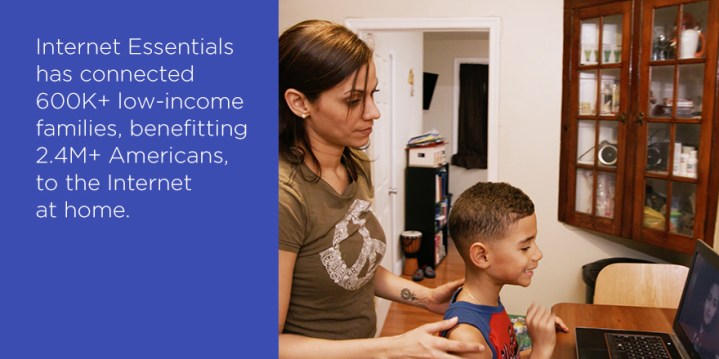
Internet Essentials Key Investments From August 2011 through December 2015, Internet Essentials has connected more than 600,000 low-income families, benefitting more than 2.4 million Americans, to the internet at home. Also since 2011, Comcast has invested more than $280 million in cash and in-kind support to help fund digital literacy training and education initiatives, reaching nearly 4.4 million people through national and local nonprofit community partners.
COMCAST AND THE U.S. DEPARTMENT OF HOUSING AND URBAN DEVELOPMENT (HUD) ANNOUNCE PILOT PROGRAM TO CLOSE THE DIGITAL DIVIDE FOR PUBLIC HOUSING RESIDENTS IN MIAMI, NASHVILLE, PHILADELPHIA, AND SEATTLE

COMCAST AND THE U.S. DEPARTMENT OF HOUSING AND URBAN DEVELOPMENT (HUD) ANNOUNCE PILOT PROGRAM TO CLOSE THE DIGITAL DIVIDE FOR PUBLIC HOUSING RESIDENTS IN MIAMI, NASHVILLE, PHILADELPHIA, AND SEATTLE

Since 2011, Internet Essentials has Connected 2.4 million Americans, or 600,000 low-income families, to the Internet at Home

PHILADELPHIA (March 24, 2016) — Comcast today announced a pilot program with the U.S. Department of Housing and Urban Development’s (HUD) ConnectHome initiative to attack the digital divide for public housing residents.  Eligibility for Internet Essentials, Comcast’s acclaimed, high-speed Internet adoption program, will be immediately extended to public housing residents in Miami-Dade County and the cities of Nashville, Philadelphia, and Seattle.  This is the eighth time in five years Comcast has expanded eligibility for Internet Essentials.

Also today, Comcast announced its latest Internet Essentials milestones.  In less than five years, the program has now connected more than 600,000 low-income families, benefitting more than 2.4 million Americans, to the Internet at home.  In fact, 2015 was the program’s single most successful year ever, with a 30 percent increase in enrollments over 2014.

IE-2016-Social-Mom-Son-Computer

Continue reading “COMCAST AND THE U.S. DEPARTMENT OF HOUSING AND URBAN DEVELOPMENT (HUD) ANNOUNCE PILOT PROGRAM TO CLOSE THE DIGITAL DIVIDE FOR PUBLIC HOUSING RESIDENTS IN MIAMI, NASHVILLE, PHILADELPHIA, AND SEATTLE”

COMCAST ANNOUNCES INTERNET ESSENTIALS PILOT

Comcast also doubles Internet speed and offers Wi-Fi at no additional cost


Comcast today announced several significant enhancements and milestones for Internet Essentials, the nation’s largest and most comprehensive high-speed Internet adoption program.  The company said it plans to conduct a pilot program for low-income senior citizens in Palm Beach County, and is doubling the service’s download Internet speed and providing a Wi-Fi router for no additional cost.

Now entering its fifth year, Internet Essentials has connected more than 275,000 low-income Floridians to online access at home, of which more than 182,000 live in the South Florida area. However disparities in Internet connectivity rates continue to persist and for the senior population the digital divide is wide.  According to Pew Research Center, just 47 percent, or less than half, of seniors (aged 65 and older) have high-speed Internet at home.  But when it comes to income level, only 25 percent of seniors with household incomes below $30,000 have home broadband, compared to 82 percent of seniors with household incomes at or above $75,000.

“We have made significant progress toward closing the digital divide for low-income parents and children across the country.  In less than four years, Internet Essentials has connected more than 500,000 families, or more than 2 million low-income Americans, to the power of the Internet at home,” said David L. Cohen, Comcast Corporation Senior Executive Vice President and Chief Diversity Officer.  “With the increase in the program’s Internet speeds and the addition of Wi-Fi, these families will have even easier access to the Internet and its life-changing resources for education, employment, healthcare, communication, and entertainment.”

The Internet Essentials pilot program for senior citizens is designed to better tackle the unique challenges of helping low-income seniors cross the digital divide and learn how to use the Internet. The first senior pilot program will take place in Palm Beach County, where Cohen was joined by City of West Palm Beach Mayor Jeri Muoio, Palm Beach County School District Superintendent Dr. Robert Avossa, and Urban League of Palm Beach County President and CEO Patrick J. Franklin to make the announcements.

“Senior citizens can be an afterthought when it comes to addressing digital literacy and use of the Internet,” said Franklin.  “However, the Internet has a tremendous power to help change their lives for the better by tearing down the walls that geography may have put between them and the ones they love.  It can also help restore a sense of community and inclusion, bonds that can weaken as we grow older.”

Comcast also announced it is doubling the speed for Internet Essentials to 10 Mbps downstream, which is enough to power multiple devices simultaneously. This is the third time in four years Comcast has increased speeds for customers. In addition, by offering Wi-Fi routers, customers will be able to connect any Internet-enabled device, such as a tablets or smartphone, which could help save money on monthly wireless bills.

To receive the faster Internet speed, customers simply need to reboot their cable modems.  Existing customers who would like a Wi-Fi router just need to call the dedicated call center and either request to have one shipped to them for free, or they can schedule a professional installation, also for no additional cost.  New customers will have the option to receive a Wi-Fi router when they sign up.

Internet Essentials Investments

In 2014, Comcast launched four new Internet Essentials Digital Learning Zones in South Florida at ASPIRA, Boys & Girls Clubs of Miami-Dade, Chapman Partnership and Overtown Youth Center (OYC), which provide additional opportunities for low-income students and families to access the Internet and receive digital literacy training.    Comcast aims to help complete the continuum of connectivity, in which students spend the school day in wired classroom, stay connected after school in Internet Essentials Learning Zones and end their days connected at home, where families have online access through the Internet Essentials program. Comcast has dedicated $1 million in grants to create these zones across the country.

Through a partnership with The Urban League of Palm Beach County, Comcast offers a Digital Connectors Program that provides digital literacy training for students in Palm Beach County. Almost 60 low-income local youth have graduated from the program, which was launched in 2007.

Through Internet Essentials, Comcast has invested more than $240 million in cash and in-kind support to help fund digital literacy and readiness training and education, reaching nearly 3.2 million people through national and local non-profit community partners.  Through the end of June 2015, Comcast has:

  • Provided more than 41,000 subsidized computers at less than $150 each.
  • Distributed for free nearly 46 million Internet Essentials program materials.
  • Broadcast more than 7 million public service announcements, valued at more than $90 million.
  • Welcomed more than 3.5 million visitors to the Internet Essentials websites in English and Spanish and its Online Learning Center.
  • Fielded more than 3.2 million phone calls to our Internet Essentials call center.
  • Offered Internet Essentials to nearly 48,000 schools and 5,000 school districts, in 39 states and the District of Columbia.
  • Partnered with thousands of community-based organizations, government agencies, and federal, state, and local elected officials to spread the word.

Follow all the news about Comcast Florida on Facebook at Facebook.com/ComcastFlorida and on Twitter @ComcastFL